

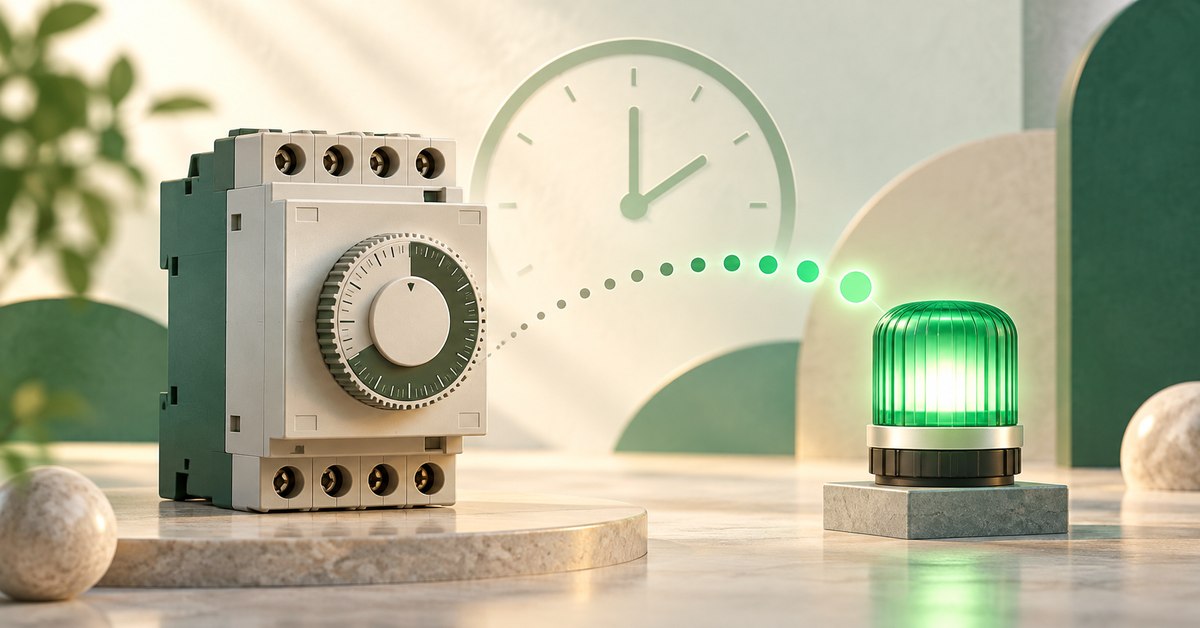
For the non-retentive ON-delay timer in this exercise: a continuous signal starts timing; the delayed NO closes after the set time. Loss of the signal resets the contact, and the next activation starts from zero.
1. What exactly is delayed?
A timer is a relay with a timing function. ON-delay waits for an interval after activation before changing its output state.
The name can suggest every contact closes after the delay. A delayed NO output starts open and closes; a delayed NC output starts closed and opens. Both may belong to the same delayed-operation function.
Here, maintained switch S1 continuously feeds KT1, whose delayed NO waits three seconds before feeding lamp H1. Switching S1 off removes activation, turns the lamp off, and resets timing. Three seconds is chosen only to make the exercise easy to observe.
2. Three moments to observe
When S1 first closes, KT1 receives power. The lamp remains off because the timed contact has not closed. Coil activation and timed output operation are different states.
After three seconds of continuous activation, the delayed NO closes. H1 lights only if its branch has a correctly connected supply and return.
If S1 opens before three seconds, timing is cancelled in this non-retentive example. Turning it on again starts a new interval; two short activations are not added together.
If you turn S1 off after the lamp lights, the output resets immediately in this ON-delay example. OFF-delay, retentive timers, and timers with separate trigger inputs behave differently; read the exact function first.
| Situation | KT1 | H1 lamp |
|---|---|---|
| S1 off | Not activated | Off |
| S1 just turned on, less than 3 seconds | Timing; timed NO still open | Off |
| S1 on continuously for 3 seconds | Timed NO closed | On |
| S1 turned off while timing | Timing stops and resets | Still off |
| S1 turned off after lamp lights | Output resets | Off |
3. Build a delayed-lamp exercise in EleRun
Use a 24 VDC supply, maintained switch S1, KT1 coil, KT1 delayed NO contact, and suitable H1 lamp. A maintained switch keeps the signal present during timing; later replace it with a push button to see the difference.
EleRun links coils and contacts by tag when symbols support the appropriate roles. Assign KT1 to both coil and timed contact, and set time in the correct symbol’s properties. Keep everything on one page before Run.
If the contact’s Delay property uses ms, three seconds means 3000 ms. Entering 3 means three milliseconds and will look almost instantaneous.
- Place the supply and maintained S1. Wire +24 V through S1 to KT1’s coil, then return the other coil terminal to 0 V.
- Create a separate lamp branch: +24 V → KT1 delayed NO → H1 → 0 V. Give the contact the same KT1 tag as the coil.
- Open the timed contact properties and set Delay to 3000 if the displayed unit is ms. Choose ON-delay, not an ordinary NO contact.
- Start Run with S1 off. Turn it on and wait: activation happens first, then the lamp lights after the delay.
- Turn S1 off and verify the lamp goes out. Turn it on for about one second, then off; turn it on again and check it waits a full new interval.
4. Why does a quick Start press not complete timing?
Replacing the maintained switch with a NO push button powers the coil only while held. Releasing after half a second removes activation before a three-second timer can finish. One press does not automatically make every timer finish its cycle.
If one Start press should begin a process, you need a suitable signal-holding circuit. A next exercise is a Start–Stop holding relay KA1 whose NO contact feeds KT1. Stop removes KA1 and the timer’s activation.
Check both requirements: releasing Start maintains the signal, and pressing Stop during timing cancels the process. Solve the holding path before focusing on the interval.
5. Lamp lights immediately or never lights: where to look?
Immediate light: check for an ordinary NO instead of a timed contact, a wire bypassing it, and incorrect units. Also start with S1 off rather than observing a timer that already completed timing.
Coil activated but lamp still off after the interval: check KT1 tags, contact type, lamp endpoints, and the 0 V return. A closed contact does not create power; the load branch needs a complete circuit.
Timer repeatedly restarts: check whether releasing a button or another contact interrupts KT1’s supply. A lamp on the coil branch can help show whether activation remains continuous.
Lamp stays on after S1 is switched off: check for OFF-delay, retentive behavior, or an unintended lamp holding branch. Read the symbol’s function instead of guessing from its clock shape.
6. Change one thing to learn one thing
After the three-second circuit works, change to one second and then five. Keep wiring unchanged so you can see the effect of the timing property.
Return to three seconds, turn S1 off near the end, then on again. In this non-retentive example the lamp must wait a new interval. Also turn it off after completion to distinguish ON-delay from OFF-delay.
This exercise prepares you for sequences where a later step waits for an earlier condition. Before combining timers, explain one: what activates it, which contact changes, and what resets it.
ELERUN LAB · TRY IT YOURSELF
Three seconds or three milliseconds?
Build S1 → KT1 and the delayed KT1 NO contact → H1 as above. Confirm that the delay property displays milliseconds.
- Run two trials changing only the delay: 3000, then 3. Turn S1 off before starting each trial.
- Why does the second trial look almost instantaneous even though the contact is still ON-delay?
Compare your reasoning
3000 ms is three seconds; 3 ms is three thousandths of a second. Both are ON-delay, but the second interval is too short to see clearly. Restore 3000 ms and check that S1 keeps the timer energized throughout the wait.
Read the unit shown by the actual symbol property. Do not copy an example delay into a real timer or machine.
7. Frequently asked questions
Does the timer supply power to the lamp after timing?

A timer contact only connects or interrupts a path. Here H1 must have its own branch from supply through the contact and back. Matching KT1 tags do not create lamp supply wiring.
How does ON-delay differ from OFF-delay?
ON-delay waits after activation before operating. OFF-delay delays resetting after loss of the signal, depending on the timer. This exercise covers only non-retentive ON-delay; do not generalize its results to all timers.
Can this timer immediately handle star–delta switching?
ON-delay explains the waiting interval. Star–delta also needs star opening first, a transition interval, and suitable interlocks; an ordinary timer does not automatically satisfy all of those requirements.
8. Manufacturer references
EleRun diagrams and exercises explain principles; they are not manufacturer-approved installation drawings.


